News
Cadmus convenes a working group to develop a new approach to oral assurance for secure assessment



Share with colleagues
Download the full Case Study
Take an in-depth look at how educators have used Cadmus to better deliver assessments.
Cadmus is excited to announce the formation of a Working Group, bringing together universities and academic leaders from APAC and the UK to collaboratively design a new approach to oral assessment for an AI-enabled world.
As generative AI reshapes how students produce assessment work, universities are increasingly seeking assessment approaches that can confidently evidence genuine understanding — without defaulting to surveillance, detection, or blanket oral exams. Across both regions, partners highlight a shared challenge: oral assessment is widely trusted, but is difficult to operationalise at scale in real university conditions, and needs to be carefully considered to support students in the best way possible while accommodating for diverse cohorts.
Through early discussions, institutions pointed to a consistent set of tensions — balancing learning and assurance, scaling across large cohorts, managing workload, supporting equity and accessibility, and meeting evolving regulatory and policy expectations. These conversations reinforced the need for a learning-centred, proportionate approach to oral assessment, embedded within the assessment journey rather than bolted on as a last-resort integrity check.
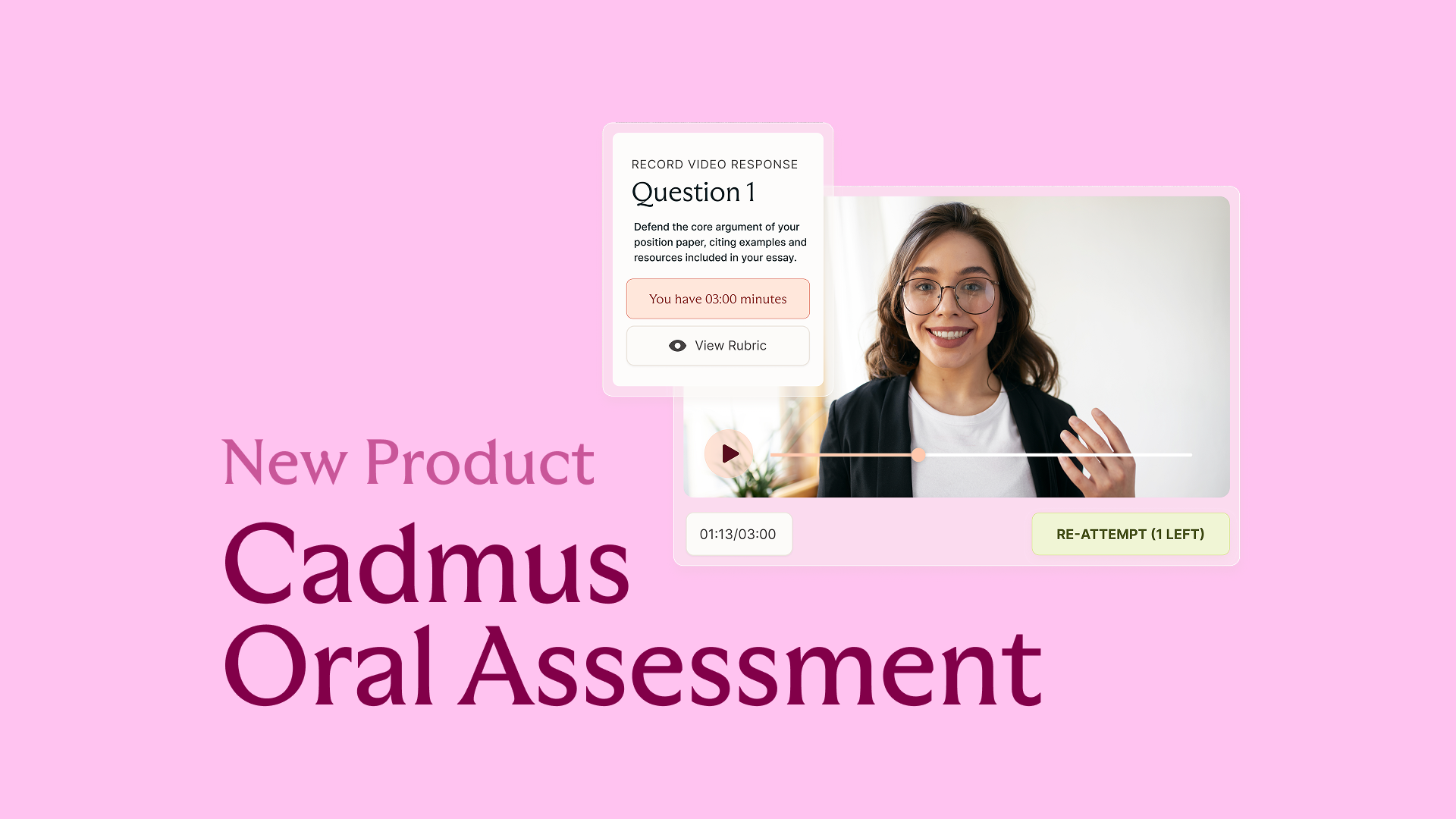
Cadmus Oral Assessment is being developed to address this gap.
The solution will be a learning-centred, educator-controlled oral assurance layer, embedded directly into existing assessment journeys. Rather than treating oral assessment as a policing mechanism, Cadmus is looking to introduce targeted, proportionate oral moments where explanation, reasoning, and knowledge ownership matter most — strengthening confidence in learning outcomes while remaining scalable, inclusive, and defensible. Most importantly, using Oral assessment as just one layer in a broader assessment ecosystem.
The solution is being shaped around the realities universities shared, including:
- Using oral assessment as a selective assurance layer, not a universal requirement — for example as an oral defence of written assessments or exams, as part of group assesments (including as a prepatory exercise), an integrity trigger, or an observed assessment within a broader programme design.
- Supporting asynchronous and digital oral assessment at scale, particularly for large undergraduate cohorts where traditional live oral assessments are challenging.
- Embedding oral assessment within learning journeys, linking to previous assessments, with low-stakes, formative experiences early on that build confidence, and more dialogic, human-led oral assessment later where judgement and synthesis matter.
- Designing oral assessment that are fair, transparent, and accessible, with clear expectations, rubric-aligned marking, and support for reasonable adjustments.
- Using AI carefully and transparently to support preparation, prompting, and scalability — while keeping academics visibly in control and firmly in the loop.
The Working Group will play a central role in shaping this solution, ensuring oral assessment reflects real academic workflows, diverse disciplinary needs, and practical implementation realities.
What this means for our existing partners
For our global partners, this innovative solution marks the beginning of a new era in higher education.
- Cadmus Webinars: We look forward to collaborating with academic leaders through our series of webinars, bringing together educators from across disciplines and regions to shape the future of secure, learning-centred oral assessment. Webinar registration coming soon.
By working in close partnership with universities from the outset, Cadmus aims to deliver a oral assessment solution that institutions can confidently adopt.
Thank you to our partners from:
- Australian Catholic University
- Charles Sturt University
- Deakin University
- Edith Cowan University
- Flinders University
- La Trobe University
- London School of Economics and Political Science
- Massey University
- Queen Mary University of London
- RMIT University
- The University of Auckland
- The University of Queensland
- The University of Waikato
- The University of Glasgow
- The University of Melbourne
- University College London
- University of Newcastle
- University of New South Wales
- University of Southern Queensland
- University of St Andrews
- University of Tasmania
- University of Warwick
- University of Western Australia
- University of Notre Dame Australia
- Victoria University
Category
Company
Product update
More News
Load more


Product
How we use data at Cadmus
Being online creates new opportunities to understand how learning happens. Discover how Cadmus uses data to support learning, improve assessment design, and build transparency and trust across every stage of the assessment process.
Cadmus
2026-03-31



Academic Integrity
Leadership
Why detection-first integrity strategies are becoming a sunk cost for universities
In this article, Founder & Co-CEO Herk Kailis puts language to a growing tension across institutions: as the market leans further into detection, the response risks becoming more reactive than strategic. Through a commercial lens, he explores how this is beginning to resemble a classic sunk cost trap, and why the stronger long-term play is to design assessments that are harder to game in the first place.
Herk Kailis, Founder & Co-CEO, Cadmus
2026-03-30


Product update
Company
Introducing Cadmus Oral Assessment: Scalable assurance for an AI‑enabled world
Cadmus introduces Oral Assessment: a new approach to strengthening assessment assurance in an AI-enabled world. Starting with scalable, asynchronous vivas, this phased solution embeds targeted oral explanation directly into assessment workflows to provide more credible evidence of student learning.
2026-03-19