News
How can teachers support students through exams?



Share with colleagues
Download the full Case Study
Take an in-depth look at how educators have used Cadmus to better deliver assessments.
As the 2025 student cohort heads into first semester exams, educators are once again tasked with supporting students through what is traditionally one of the most stressful times of year. For many students—particularly those who began their university journey online or in hybrid formats—this may be the first time they are sitting formal, invigilated exams. Others may be navigating a mix of online and in-person assessments for the first time.
The challenge of managing multiple exam formats, blended learning expectations, and the ongoing aftershocks of a disrupted education system continues to put pressure on both students and teachers.
Exams remain a critical juncture in the student journey—often influencing decisions to continue or withdraw from study.
In Australia and across the globe, student retention remains a growing concern. While universities have largely returned to on-campus operations, the long-term impacts of the pandemic and the rising cost of living are still being felt. In the UK, for example, student withdrawals rose sharply in 2024, with over 20,000 students leaving their courses before the end of the academic year—signalling the ongoing strain on learners.
So how can educators better support students during this pivotal time in a post-COVID, tech-integrated learning environment?
Help students take charge
The first point of call for teachers is to help students manage their own stress during a busy time. Often the first step is to help students recognise the stress and begin to develop processes to manage it themselves — an important lesson they can carry forward.
Most universities will have resources you can direct students towards, looking at different methods for managing stress. For example:
-
Putting the stress into perspective
-
Continuing to maintain their wellbeing through mindfulness, exercise and connection with their support network
-
Maintaining sleep
-
Limiting reliance on substances like caffeine or energy drinks to study longer
-
Accessing university counselling or support services for additional assistance
Here's an example from The University of Melbourne, which has a great online portal for student wellbeing during exam time.
Platform preparation is key
Regardless of how students are completing exams, it helps to be familiar with the environment. For many students, picking up a pen for an invigilated exam might feel foreign unless they have practised. Likewise, the best way to approach exams will vary between disciplines and types of tests, which is another way teachers can begin to prepare their students for success.
Just as important, is familiarising students with any technology they will use to conduct exams and assessments. If you are using Cadmus you can begin to prepare your students by setting up a practice exam in the platform, or providing an open assessment space for students to explore the functionality and understand key workflows.
Prevention is better than punishment
Where there are exams, there will always be measures in place to protect academic integrity — and it is certain that prevention is far better than punishment.
Professor Angela Hill, the Deputy Vice-Chancellor (Education) at Edith Cowan University, explained that many students found to have breached academic integrity admitted they started their assessments too late and panicked.
This rings true for exam periods too. The greater the pressure the student is under the more likely they will be to look for assistance.
“The idea is that we need to scaffold and support students to really engage early,” Professor Hill said.
By giving students plenty of time to prepare, along with clearly defined standards and objectives, teachers can guide students towards success. And with the right technology and support, students will have the scaffolding they need to approach exams with as much confidence as possible.
Category
Teaching & Learning
More News
Load more


Product
How we use data at Cadmus
Being online creates new opportunities to understand how learning happens. Discover how Cadmus uses data to support learning, improve assessment design, and build transparency and trust across every stage of the assessment process.
Cadmus
2026-03-31



Academic Integrity
Leadership
Why detection-first integrity strategies are becoming a sunk cost for universities
In this article, Founder & Co-CEO Herk Kailis puts language to a growing tension across institutions: as the market leans further into detection, the response risks becoming more reactive than strategic. Through a commercial lens, he explores how this is beginning to resemble a classic sunk cost trap, and why the stronger long-term play is to design assessments that are harder to game in the first place.
Herk Kailis, Founder & Co-CEO, Cadmus
2026-03-30


Product update
Company
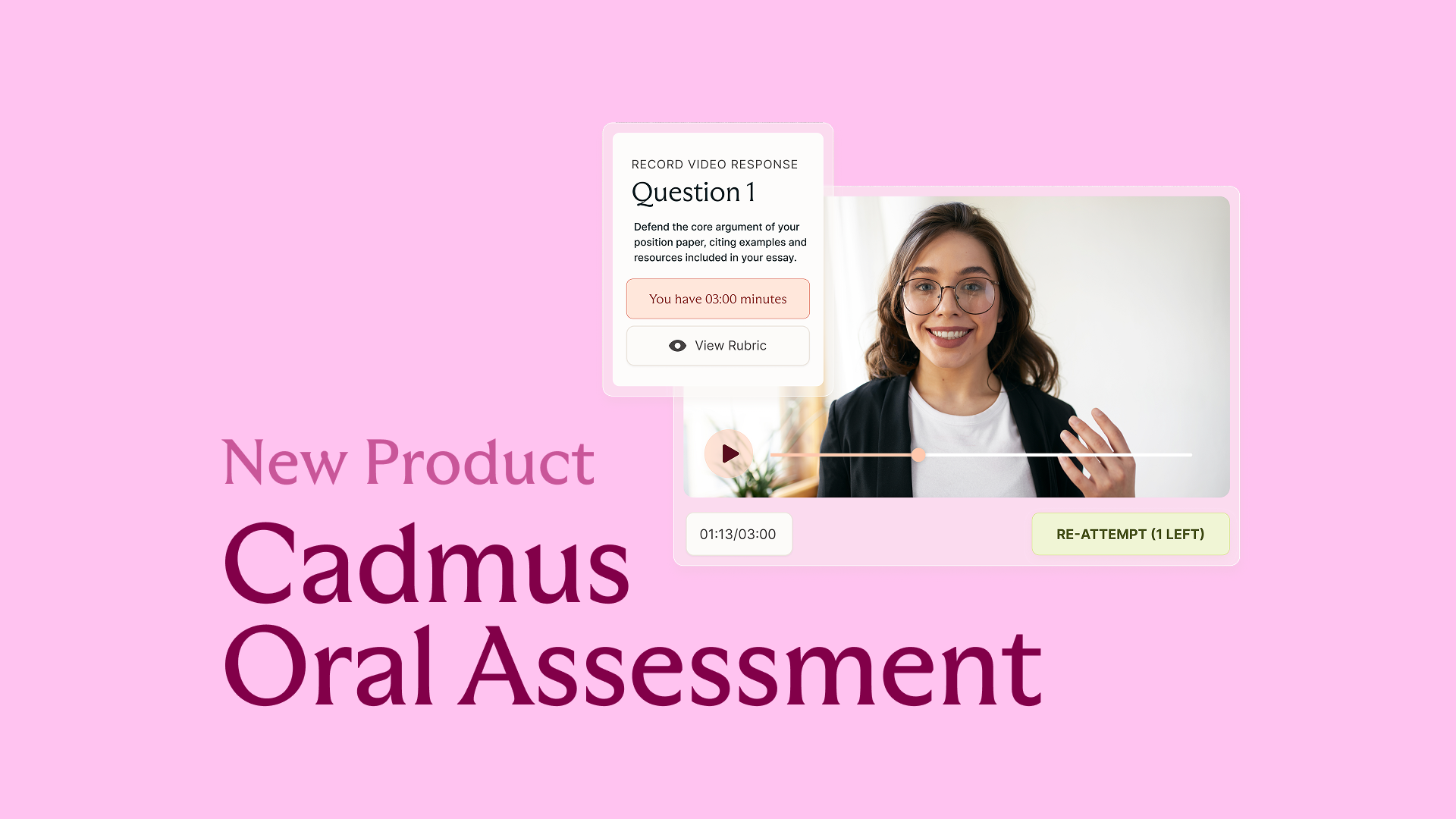
Introducing Cadmus Oral Assessment: Scalable assurance for an AI‑enabled world
Cadmus introduces Oral Assessment: a new approach to strengthening assessment assurance in an AI-enabled world. Starting with scalable, asynchronous vivas, this phased solution embeds targeted oral explanation directly into assessment workflows to provide more credible evidence of student learning.
2026-03-19