News
The hidden lever for student success: Assessment design



Share with colleagues
Download the full Case Study
Take an in-depth look at how educators have used Cadmus to better deliver assessments.
As a new semester begins, assignments are being released to students across universities. These tasks will shape how students learn in the months ahead: where they focus their effort, how they approach research and writing, and how confidently they demonstrate their knowledge.
For institutions focused on improving student outcomes, this moment is more significant than it might first appear. Increasingly, universities are recognising that assessment design is one of the most powerful levers for engagement, equity, and academic integrity.
Few elements of the learning experience influence student behaviour as strongly as assessment. It determines what students prioritise, how they organise their effort, and the kinds of skills they ultimately develop.
When assessment environments are clear, scaffolded, and designed to support authentic work, the impact is significant. Students engage more consistently, expectations become more transparent, and institutions are better positioned to support meaningful learning.
Across the sector, universities are beginning to put this thinking into practice. The examples below show how institutions are redesigning assessment environments to improve engagement, strengthen academic integrity, and deliver better outcomes for students.
1. Structured assessment improves learning outcomes
One of the most immediate ways universities are improving outcomes is by bringing more structure to the assessment process itself.
At Bond University, academics redesigned assessments to provide clearer guidance and structure throughout the writing process.
Rather than presenting assessment as a single submission task, students were supported through clear drafting stages, supportive prompts, embedded AI tool guidance, and opportunities for feedback as they developed their work.
The impact was measurable:
- 4.3% improvement in average student grades
- 77.8% of educators reported increased student progress and engagement
- 84% of students reported a good to excellent assessment experience
By supporting students throughout the process of constructing their assessment, rather than only evaluating the final submission, educators were able to encourage stronger engagement and more consistent performance.
This example highlights that when assessments guide learning rather than simply measure it, students are better positioned to succeed.
2. Embedded support increases engagement and equity
Structure alone, however, is only part of the picture. For many institutions, improving outcomes also means ensuring all students can access the support they need while completing assessments.
At The University of Manchester, assessment reform focused on making assessments more inclusive and accessible across a diverse student population.
Through redesigned hybrid assessments, students received integrated academic skills support, referencing guidance, and step-by-step checklists directly within the assessment environment.
Across more than 6,800 students, the results showed strong engagement with these resources:
- 96% of students used academic support resources
- 83% accessed real-time educator feedback during the assessment process
- 96.31% achieved a passing grade
- 88.96% of students reported a positive assessment experience
Importantly, the reforms were also designed to address attainment gaps affecting underrepresented and minority student groups.
By embedding guidance directly into the assessment environment, students were better able to understand expectations, access support, and complete tasks successfully.
3. Digital assessment can improve the high-stakes exam experience
Assessment transformation is not limited to coursework. Universities are also rethinking how high-stakes exams can better support students while maintaining academic integrity.
At the University of Melbourne, the university introduced large-scale digital in-place exams, allowing students to complete assessments on their own devices in exam halls.
In the first semester alone, the initiative delivered strong results:
- More than 38,000 digital exams were delivered across three major faculties: Medicine, Dentistry and Health Sciences; Business and Economics; and Law
- 0 cases of academic misconduct were recorded
- 82.47% of students reported a positive exam experience
Exams are often one of the most stressful moments in a student’s academic experience. In these high-pressure environments, students should be able to focus on demonstrating their knowledge and doing their best work.
By introducing a familiar digital assessment environment, the university was able to remove some stressors. Features such as autosave, digital submission, and consistent interfaces helped students focus on the task at hand, while maintaining the integrity and reliability expected of high-stakes assessments.
4. Authentic assessment strengthens understanding in an AI-enabled world
As generative AI reshapes higher education, universities are also rethinking how assessments can continue to support genuine learning and authentic student work.
At Zayed University, educators introduced a data-driven model that has become the foundation for institution-wide digital assessment reform across all faculties—clarifying expectations, strengthening academic skills, and guiding students through the process of developing their work.
Rather than treating integrity as a compliance exercise, the approach focused on helping students understand how to construct and present their ideas. Scaffolded templates, embedded academic guidance, and real-time feedback supported students throughout the writing process.
The results were significant:
- 83.3% of students reported greater understanding of assessment requirements and were more likely to seek academic support
- 100% found assessments easy to use and resources accessible
- Academic misconduct declined by 60%
- 93.6% rated their overall experience as good to excellent
Students also benefited from a consistent digital workspace where expectations, resources, and feedback were visible in one place. This clarity reduced confusion while encouraging deeper engagement with their work.
In an AI-enabled learning environment, this kind of authentic assessment design becomes even more important. When students are guided through the process of developing ideas, reflecting on their thinking, and demonstrating their understanding, assessments become more resilient to misuse of AI while also strengthening genuine learning.
What the evidence suggests
Despite differences in size, geography, and discipline, several consistent patterns emerge across institutions.
Structured assessments drive engagement
Clear expectations, staged prompts, and guided workflows help students focus their effort and reduce confusion.
Integrated support improves completion and success
When feedback and academic skills resources are embedded directly within assessments and easy to access, students are far more likely to use them than if they need to locate support elsewhere.
Authentic assessment strengthens learning
Designing assessments around genuine work processes encourages students to develop and demonstrate real understanding. By guiding students through planning, drafting, feedback, and reflection, assessments shift from simply testing knowledge to actively supporting learning.
Consistency improves the student experience
Reliable, consistent assessment environments allow students to focus on learning rather than navigating different systems, formats, or expectations. This consistency is particularly valuable in high-stakes environments, where reducing unnecessary stress can help students perform at their best.
Rethinking assessment for the future
Universities are under increasing pressure to improve student outcomes while maintaining academic integrity and supporting increasingly diverse student cohorts. Across the sector, institutions are increasingly recognising the critical role that assessment design plays in supporting student success.
When assessments are:
- clearly structured
- supported by embedded guidance
- designed for authentic work
- delivered through reliable digital environments
students are better positioned to engage deeply with their learning and demonstrate what they know.
When assessment is designed to support learning—not simply measure it—students are far better positioned to succeed.
Category
Student Success
Assessment Design
More News
Load more


Product
How we use data at Cadmus
Being online creates new opportunities to understand how learning happens. Discover how Cadmus uses data to support learning, improve assessment design, and build transparency and trust across every stage of the assessment process.
Cadmus
2026-03-31



Academic Integrity
Leadership
Why detection-first integrity strategies are becoming a sunk cost for universities
In this article, Founder & Co-CEO Herk Kailis puts language to a growing tension across institutions: as the market leans further into detection, the response risks becoming more reactive than strategic. Through a commercial lens, he explores how this is beginning to resemble a classic sunk cost trap, and why the stronger long-term play is to design assessments that are harder to game in the first place.
Herk Kailis, Founder & Co-CEO, Cadmus
2026-03-30


Product update
Company
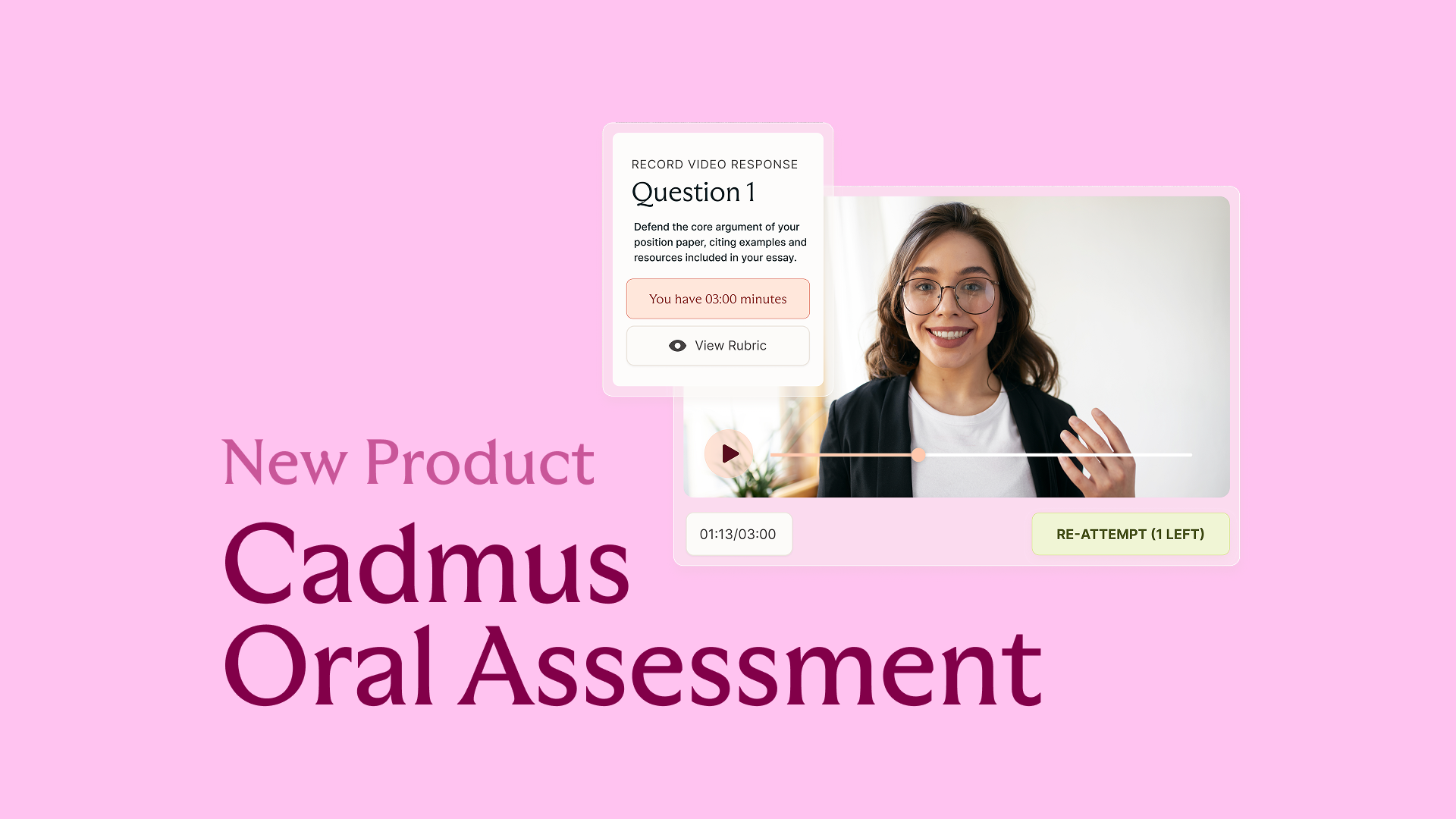
Introducing Cadmus Oral Assessment: Scalable assurance for an AI‑enabled world
Cadmus introduces Oral Assessment: a new approach to strengthening assessment assurance in an AI-enabled world. Starting with scalable, asynchronous vivas, this phased solution embeds targeted oral explanation directly into assessment workflows to provide more credible evidence of student learning.
2026-03-19