News
Cadmus’s established AI detection capabilities combat ChatGPT



Share with colleagues
Download the full Case Study
Take an in-depth look at how educators have used Cadmus to better deliver assessments.
As the higher education sector pivots to implement solutions and policies that mitigate students’ use of artificial intelligence platforms such as ChatGPT to generate assessments, Cadmus continues to support universities globally with long-established and sophisticated academic integrity capabilities.
Used in 50+ countries, Cadmus is the world’s first authentic assessment for learning platform developed in partnership with the University of Melbourne, purposefully built with sophisticated learner analytics to support and detect the authenticity of students’ work.
Herk Kailis, Chief Executive Officer of Cadmus, said of the recent uptake of popular AI platform ChatGPT, “Students using AI-generated content to develop their assessments and present this as their own is another form of contract cheating, and the Cadmus platform has already been long developed to detect this.”
“Within Cadmus, educators have access to real-time analytics, which monitor the process around students’ development of their assessment rather than trying to catch AI-generated content at the point of submission. Educators can identify how many hours a student has spent writing their assessment in Cadmus, if the work was copied and pasted or transcribed into Cadmus, and the source from which the work originated.”
The University of Melbourne, Australia’s highest-ranked university and member of the Group of Eight (Go8), said they would continue to rely on Cadmus’s platform capabilities to support them through this wave of innovation.
“The institution will continue to partner with Cadmus to improve assessment methodology and combat contract cheating. Cadmus is now a market-leading solution that helps academics to develop and deliver authentic assessment and minimise academic integrity risks by addressing the problem ‘at the source’ – that is, during the student’s engagement in their assessment task.”
“Because students must develop their assessment responses within the Cadmus environment, it provides a high level of certainty over the authenticity of the work presented for grading,” said David Israel, Director of Educational Innovation and Commercial Development at the University of Melbourne.
In the United Kingdom, Vice Dean for Teaching, Learning and Students at the University of Manchester, Professor Gabrielle Finn, said “The University has commenced education sessions and briefings with academics on how best to utilise Cadmus analytics to identify the authenticity of students’ work. Digital evolution of platforms such as ChatGPT won’t go away; they will only become more sophisticated. This reinforces the need for higher education to move to authentic, real-world assessment practices, so we can embrace digital innovation as it continues to arise.”
Already underway, the Cadmus product team are developing preventative measures to help students understand the limitation of using tools such as ChatGPT. For educators, access to richer analytics is being prioritised to help identify assessment submissions that have been created inauthentically. Both will be released in time for Semester 1, 2023.
Media Contact: Chief Marketing Officer, Bess Brennan, Bess@cadmus.io
Category
Product
Student Success
Academic Integrity
Company
More News
Load more


Product
How we use data at Cadmus
Being online creates new opportunities to understand how learning happens. Discover how Cadmus uses data to support learning, improve assessment design, and build transparency and trust across every stage of the assessment process.
Cadmus
2026-03-31



Academic Integrity
Leadership
Why detection-first integrity strategies are becoming a sunk cost for universities
In this article, Founder & Co-CEO Herk Kailis puts language to a growing tension across institutions: as the market leans further into detection, the response risks becoming more reactive than strategic. Through a commercial lens, he explores how this is beginning to resemble a classic sunk cost trap, and why the stronger long-term play is to design assessments that are harder to game in the first place.
Herk Kailis, Founder & Co-CEO, Cadmus
2026-03-30


Product update
Company
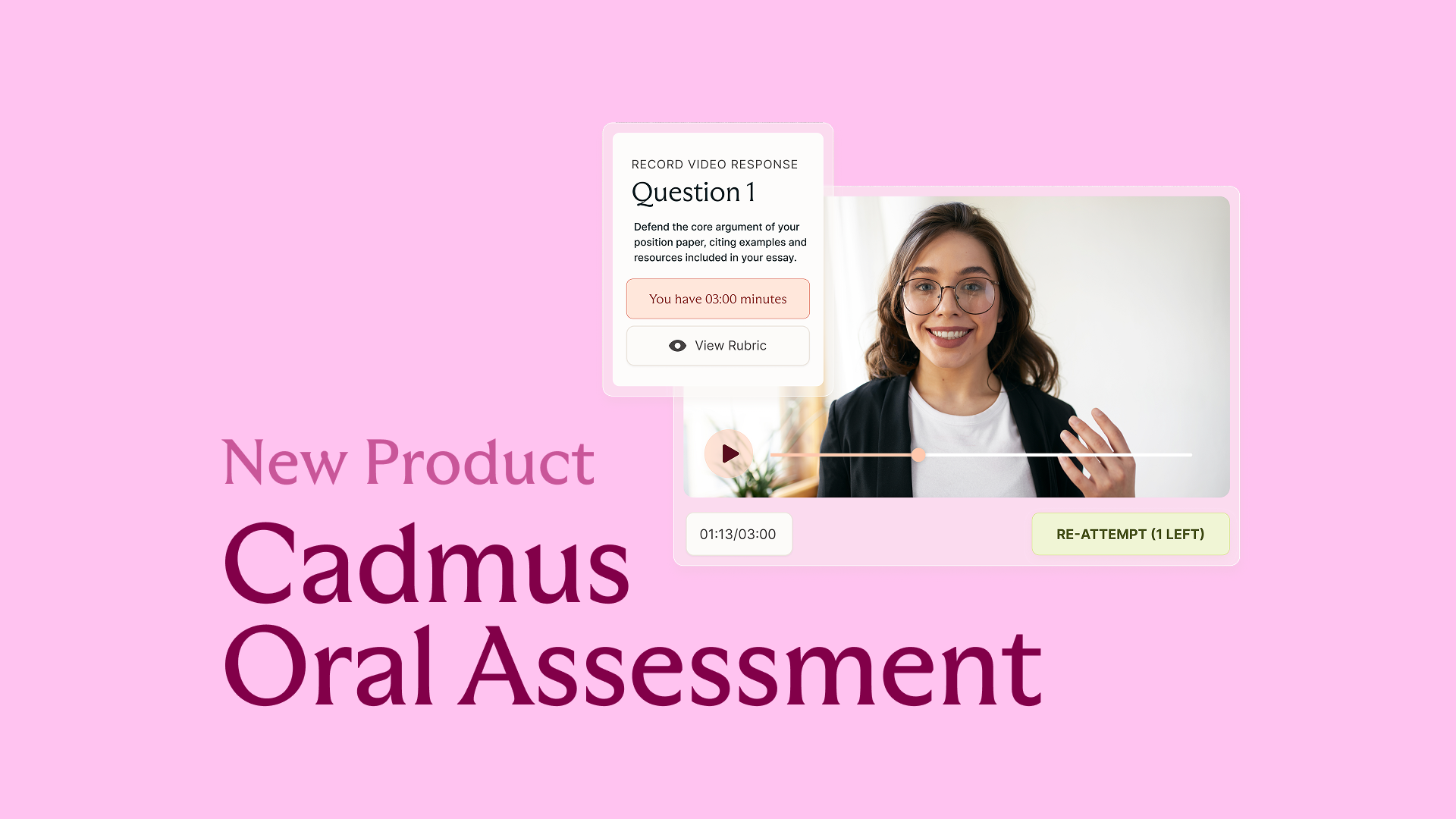
Introducing Cadmus Oral Assessment: Scalable assurance for an AI‑enabled world
Cadmus introduces Oral Assessment: a new approach to strengthening assessment assurance in an AI-enabled world. Starting with scalable, asynchronous vivas, this phased solution embeds targeted oral explanation directly into assessment workflows to provide more credible evidence of student learning.
2026-03-19