News
Independent ROI analysis: What the findings mean for Universities



Share with colleagues
Download the full Case Study
Take an in-depth look at how educators have used Cadmus to better deliver assessments.
Universities are under increasing pressure to strengthen student outcomes while maintaining financial sustainability. Retention, progression, and assessment quality are no longer separate conversations: they are directly linked.
In February 2026, Nous Group completed an independent ROI analysis of Cadmus, modelling the financial and academic impact observed across universities in Australia and the UK.
The findings confirm a clear institutional chain: Stronger assessment design improves student outcomes. Improved student outcomes strengthen progression and retention. And Stronger retention delivers measurable financial return.
This confirms that assessment quality is not just pedagogical — it is strategic infrastructure.Here are some of the biggest takeaways from the study and report.
1. Early Withdrawal Reduction Is Measurable
Pre-census withdrawals create immediate tuition revenue loss, often driven by early disengagement, or uncertainty around assessment expectations.
Across University partners, Cadmus was associated with an average 2.7% reduction in pre-census withdrawals (2.9% max).
As Zac Ashkanasy, Principal and Global Head of Higher Education at Nous Group, explains:
“Our analysis shows that Cadmus is consistently associated with fewer early withdrawals and stronger academic performance.”
When assessment clarity improves and students engage earlier, withdrawal risk declines. Even small percentage improvements, applied at scale, translate into significant institutional value.
2. Academic Performance Drives Progression and Retention
Retention is strongly correlated with early academic success. The modelling translated observed grade uplift into estimated progression benefits.
Across pilots, Cadmus was associated with a 2.7% average grade improvement (7% max), with retention uplift accounting for approximately 60% of total estimated financial benefit.
Ashkanasy notes:
“Our analysis shows that Cadmus delivers measurable improvements in grades and progression, demonstrating that high-quality assessment design can materially strengthen retention.”
This is the compounding effect: Clearer expectations → stronger performance → higher progression → improved retention.
And retention is the primary financial driver.
3. The Financial Impact Is Significant
When modelling reduced withdrawals and improved retention against tuition revenue and marginal teaching costs, the results demonstrate a clear return.
The weighted average ROI across universities is 7.1x.
With an average ROI across regions:
- Australia: 8.6x
- UK: 4.3x
Importantly, ROI increases as Cadmus is deployed across more modules and student cohorts meaning benefits compound as adoption and scaling expands.
The modelling applies conservative attribution factors and clearly outlines assumptions, reinforcing credibility for institutions building internal investment cases.
4. What This Means for University Leaders
The findings position assessment not simply as an academic tool, but as an institutional lever.
By strengthening assessment design, institutions can:
- Improve student outcomes
- Strengthen progression and retention
- Preserve and grow tuition revenue
- Build a defensible, evidence-based case for investment
And as evidenced, institutions using Cadmus:
- Reduce early attrition
- See stronger academic progression
- Improve student experience
- Scale financial impact
As Ashkanasy summarises:
“Our ROI findings highlight that Cadmus is more than an assessment platform; it is a strategic investment that improves student outcomes.”
A Strategic Shift in Thinking About Assessment
The independent analysis underscores makes one point clear: Assessment quality drives student success. Student success drives retention. And retention drives financial sustainability.
In an outcomes-driven environment, assessment is no longer just an academic concern — it is an institutional growth lever.
The full ROI report details the modelling methodology, assumptions, and pilot data underpinning these findings.
Category
Assessment Design
Company
More News
Load more


Product
How we use data at Cadmus
Being online creates new opportunities to understand how learning happens. Discover how Cadmus uses data to support learning, improve assessment design, and build transparency and trust across every stage of the assessment process.
Cadmus
2026-03-31



Academic Integrity
Leadership
Why detection-first integrity strategies are becoming a sunk cost for universities
In this article, Founder & Co-CEO Herk Kailis puts language to a growing tension across institutions: as the market leans further into detection, the response risks becoming more reactive than strategic. Through a commercial lens, he explores how this is beginning to resemble a classic sunk cost trap, and why the stronger long-term play is to design assessments that are harder to game in the first place.
Herk Kailis, Founder & Co-CEO, Cadmus
2026-03-30


Product update
Company
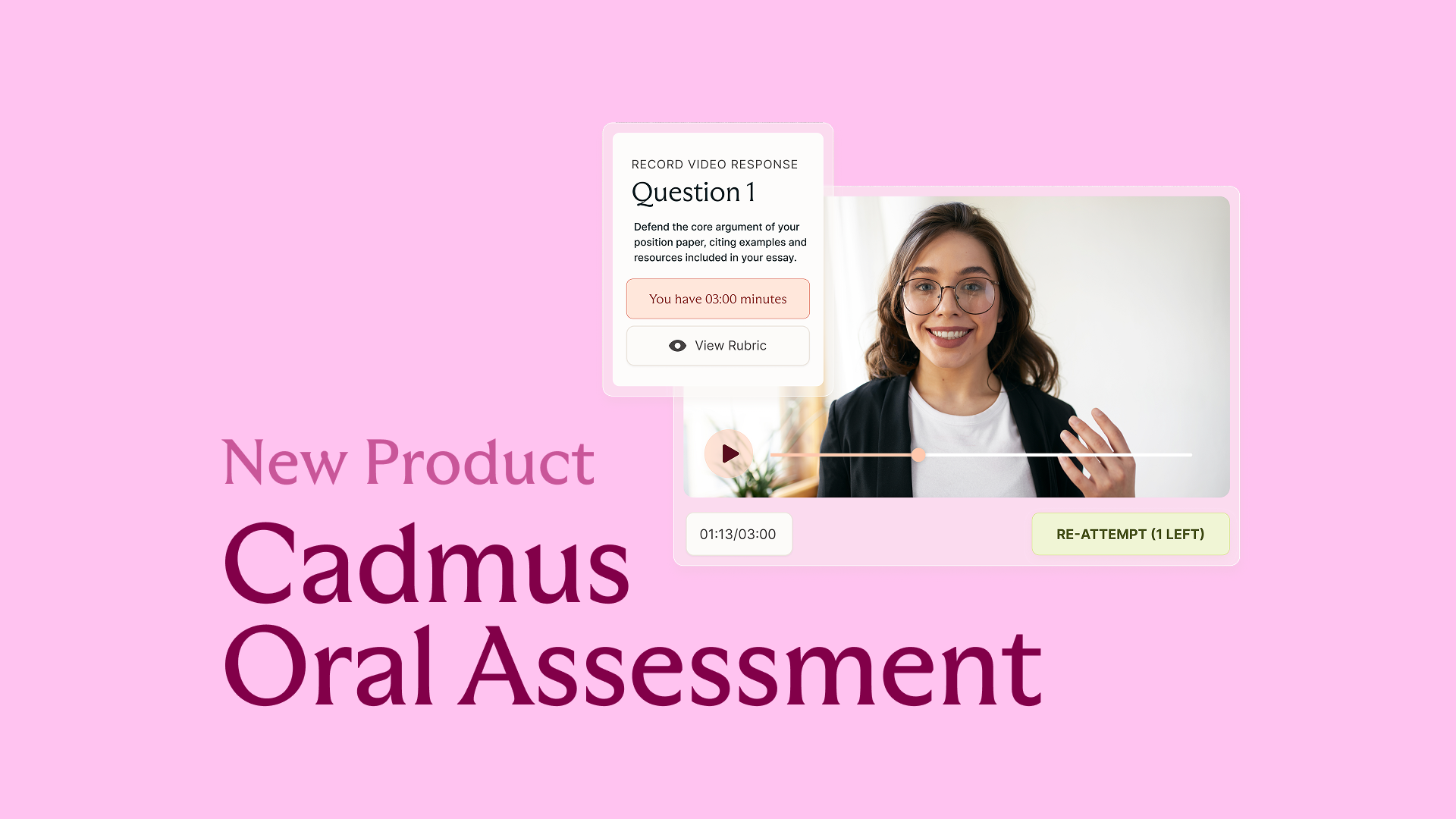
Introducing Cadmus Oral Assessment: Scalable assurance for an AI‑enabled world
Cadmus introduces Oral Assessment: a new approach to strengthening assessment assurance in an AI-enabled world. Starting with scalable, asynchronous vivas, this phased solution embeds targeted oral explanation directly into assessment workflows to provide more credible evidence of student learning.
2026-03-19