News
Group work is not the problem. Poor design is.



Share with colleagues
Download the full Case Study
Take an in-depth look at how educators have used Cadmus to better deliver assessments.
Few aspects of university assessment generate as much debate as group work.
Students raise concerns about unequal contribution. Academics grapple with how to fairly evaluate individual performance within collaborative work. Universities respond by emphasising mechanisms intended to ensure accountability and equitable grading.
Recently, the topic resurfaced at the Universities Australia Solutions Summit. But focusing the conversation primarily on freeloading risks missing the deeper issue.
Many of the challenges associated with group work are not caused by students.
They are the result of assessment design—particularly when collaboration happens without clear structure or visibility for educators.
The real problem: universities intervene too late
In many courses, universities only step in once something has already gone wrong.
At that point, academics are asked to:
- calculate contribution percentages
- redistribute marks
- mediate group conflict
- determine who “did the work”
These are reactive solutions to problems that have already escalated. In many cases, they arise because educators have limited visibility into how groups are actually working together during the assessment process.
When collaboration happens largely out of sight, problems often only become visible once the assessment has already gone off track. By the time a lecturer is reviewing contribution disputes, the assessment has already fallen short of one of its central purposes: supporting effective collaboration while providing a fair basis for evaluating student capability.
Across many institutions, academics are recognising that group work challenges are often structural rather than behavioural.
When collaborative assessments are loosely structured, the process can become unpredictable, opaque, and stressful for both students and academics.
This can be particularly difficult in diverse student cohorts, where differences in communication styles, academic preparation, language confidence, or cultural expectations about teamwork can shape how students participate.
Without clear structures, these differences can easily be misinterpreted as unequal effort or disengagement.
But when designed intentionally, group work can become a valuable way to assess capabilities that individual assignments rarely capture.
Why group work matters more than ever
Universities don’t include group work simply for efficiency.
At its best, collaborative assessment develops capabilities students will use throughout their professional lives:
- negotiating roles and responsibilities
- managing competing priorities
- resolving disagreements
- integrating different perspectives
- delivering shared outcomes under time pressure
These are not theoretical skills. They are core workplace capabilities.
They are also the kinds of capabilities that emerge when students learn to work with people whose perspectives, experiences, and approaches may differ from their own.
In an AI-enabled world, these capabilities become even more important.
While AI can support individual writing or analysis, it cannot replace the complex interpersonal dynamics required to work effectively in teams. Designing assessment that requires coordination, accountability, and shared problem-solving can strengthen authenticity in ways traditional assignments cannot.
But this only works if collaboration is structured deliberately.
Moving upstream: designing group work for fairness
Instead of focusing solely on contribution tracking, institutions are increasingly shifting attention upstream to the conditions that make teamwork successful.
Four design principles are particularly important.
1. Clarify roles and expectations early
Many group conflicts emerge because expectations are ambiguous.
Students are told to “work as a team” but are rarely given structure for how that collaboration should operate.
Clear role definitions, shared responsibilities, and transparent expectations help students understand how work should be distributed from the beginning.
2. Build visible milestones into the process
Large group projects often fail because progress remains invisible until the final submission.
Structured milestones change this dynamic.
Breaking projects into stages with defined tasks and timelines creates natural points where work becomes visible. Educators can see how projects are progressing, identify groups that may be falling behind, and provide guidance before issues escalate.
This shifts group work from a “submit at the end” model to a process that academics can monitor and support throughout the project.
It also helps ensure collaboration develops gradually rather than becoming a last-minute scramble before submission.
3. Make contribution visible through process evidence
A common response to group work challenges is to rely on retrospective contribution reporting at the end of a project.
But retrospective claims can be difficult to verify.
An alternative approach is to capture evidence of collaboration as the work unfolds. Rather than relying on students to describe what happened after the fact, the process itself provides a record of how work was developed.
This might include:
- documented planning and task allocation
- iterative drafting and feedback cycles
- records of contributions within shared project workspaces
- reflective commentary on group decisions
When the process of collaboration leaves a clear trail of evidence, individual contributions become easier to evaluate—and disputes become far less common.
4. Support conflict management before breakdown occurs
Team conflict is not inherently negative.
In many cases, disagreement is a natural part of collaborative work. Different perspectives, priorities, and working styles can improve the quality of the final outcome when they are managed constructively.
The challenge is that in many group assessments, academics have limited visibility into how collaboration is unfolding.
Without insight into task progress, participation, or communication within the group, issues often only become visible once deadlines are at risk.
When collaboration happens within structured environments where task allocation, contributions, and discussions are visible, academics are better positioned to identify emerging issues early and support groups before conflicts escalate.
In this sense, good assessment design does not eliminate conflict.
It creates transparency around the collaborative process, making it easier for both students and academics to address challenges productively.
Reframing fairness in group assessment
When group work is designed poorly, fairness becomes difficult to guarantee.
But when structured intentionally, collaborative assessment can actually strengthen fairness rather than weaken it.
Well-designed group assessments make participation more visible, expectations clearer, and collaboration more structured. This can be particularly important in diverse classrooms, where students may approach teamwork with different experiences, communication styles, and levels of confidence.
Rather than assuming a single mode of participation, structured collaboration allows different forms of contribution to become visible and valued.
Students are therefore assessed not only on what they produce individually, but on how they:
- coordinate with others
- manage responsibilities
- contribute to shared outcomes
- demonstrate professional accountability
These are capabilities universities increasingly expect graduates to demonstrate.
The challenge is not whether group work should exist in assessment.
The challenge is designing it well.
The shift universities are beginning to make
Across the sector, conversations about group work are slowly moving beyond the narrow question of freeloading.
Instead, institutions are starting to ask:
- How can we design collaborative assessment that develops real professional capabilities?
- How can we make teamwork visible and assessable?
- How can we support students before problems occur, rather than adjudicating disputes afterwards?
These questions move the conversation upstream—from contribution tracking to capability design.
And that shift may ultimately determine whether group work continues to be seen as a source of frustration… or as a genuinely valuable part of the university learning experience.
Category
Assessment Design
Student Success
More News
Load more


Product
How we use data at Cadmus
Being online creates new opportunities to understand how learning happens. Discover how Cadmus uses data to support learning, improve assessment design, and build transparency and trust across every stage of the assessment process.
Cadmus
2026-03-31



Academic Integrity
Leadership
Why detection-first integrity strategies are becoming a sunk cost for universities
In this article, Founder & Co-CEO Herk Kailis puts language to a growing tension across institutions: as the market leans further into detection, the response risks becoming more reactive than strategic. Through a commercial lens, he explores how this is beginning to resemble a classic sunk cost trap, and why the stronger long-term play is to design assessments that are harder to game in the first place.
Herk Kailis, Founder & Co-CEO, Cadmus
2026-03-30


Product update
Company
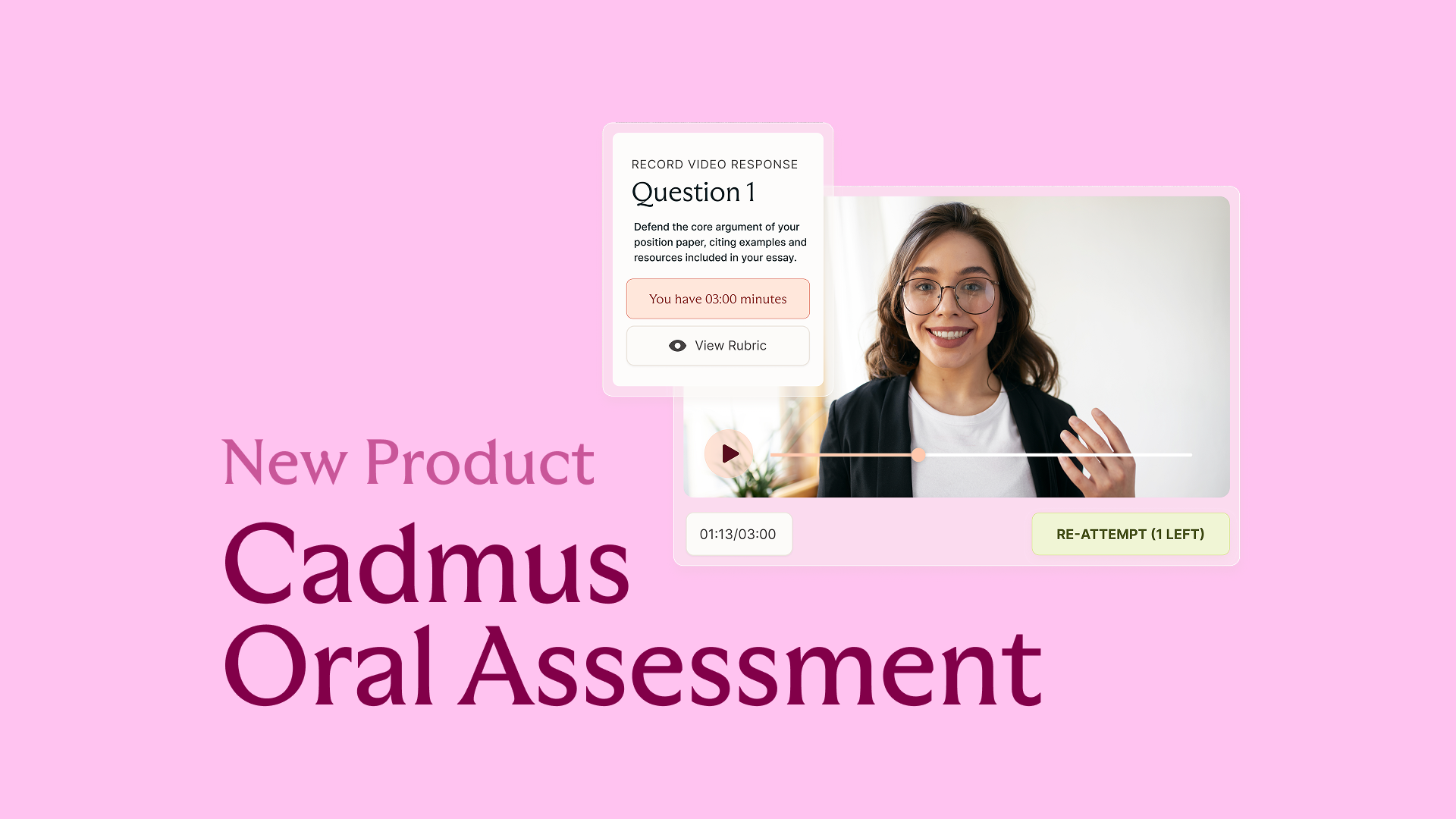
Introducing Cadmus Oral Assessment: Scalable assurance for an AI‑enabled world
Cadmus introduces Oral Assessment: a new approach to strengthening assessment assurance in an AI-enabled world. Starting with scalable, asynchronous vivas, this phased solution embeds targeted oral explanation directly into assessment workflows to provide more credible evidence of student learning.
2026-03-19