News
Keep students engaged: continuous assessment in Cadmus



Share with colleagues
Download the full Case Study
Take an in-depth look at how educators have used Cadmus to better deliver assessments.
As an educator, there’s often a balance you need to find between providing students with ongoing opportunities to improve, and managing your own workload. Continuous assessment is a great way to better engage your students, but it might seem impossible to introduce, without it completely taking over your workload.
Cadmus gives you the opportunity to individually engage students through assessment tasks, in a simplified environment. Students can easily access resources, write responses to tasks, and then submit. By setting up assessments in Cadmus, you have insight into whether or not students are actually engaging with the material and completing pre-class work. This means you can take actions to guide their learning and ensure they’re able to get the most out of class time.
If you’re starting to think about how continuous assessment could fit into your teaching, here’s an example of what it might look like with Cadmus…
Steve’s Continuous Assessment Design
Steve runs a 3rd-year History subject with 95 students. He wants his students to develop an understanding of the content, improve their academic writing skills and come prepared for discussions during tutorials. Steve wants to achieve this through weekly reading responses that students complete before tutorials.
Here’s how he structures his assessment with Cadmus:
-
Steve sets up a Cadmus assignment in the LMS for every week of tutorials, attaching relevant readings and videos to each
-
He releases each assignment to students as he covers the topic areas in his lectures
-
Using Cadmus Learning Analytics, Steve can see how his class is progressing and how students are engaging with resources in Cadmus
-
His students submit their written responses through Cadmus before the tutorial
-
Steve reviews a selection of submissions and shares group feedback by updating the Cadmus assignment instructions
-
During the tutorial, students come prepared and are able to participate in class discussions
-
Students refer to the feedback in Cadmus to improve for the following week’s submission
Category
Assessment Design
More News
Load more


Product
How we use data at Cadmus
Being online creates new opportunities to understand how learning happens. Discover how Cadmus uses data to support learning, improve assessment design, and build transparency and trust across every stage of the assessment process.
Cadmus
2026-03-31



Academic Integrity
Leadership
Why detection-first integrity strategies are becoming a sunk cost for universities
In this article, Founder & Co-CEO Herk Kailis puts language to a growing tension across institutions: as the market leans further into detection, the response risks becoming more reactive than strategic. Through a commercial lens, he explores how this is beginning to resemble a classic sunk cost trap, and why the stronger long-term play is to design assessments that are harder to game in the first place.
Herk Kailis, Founder & Co-CEO, Cadmus
2026-03-30


Product update
Company
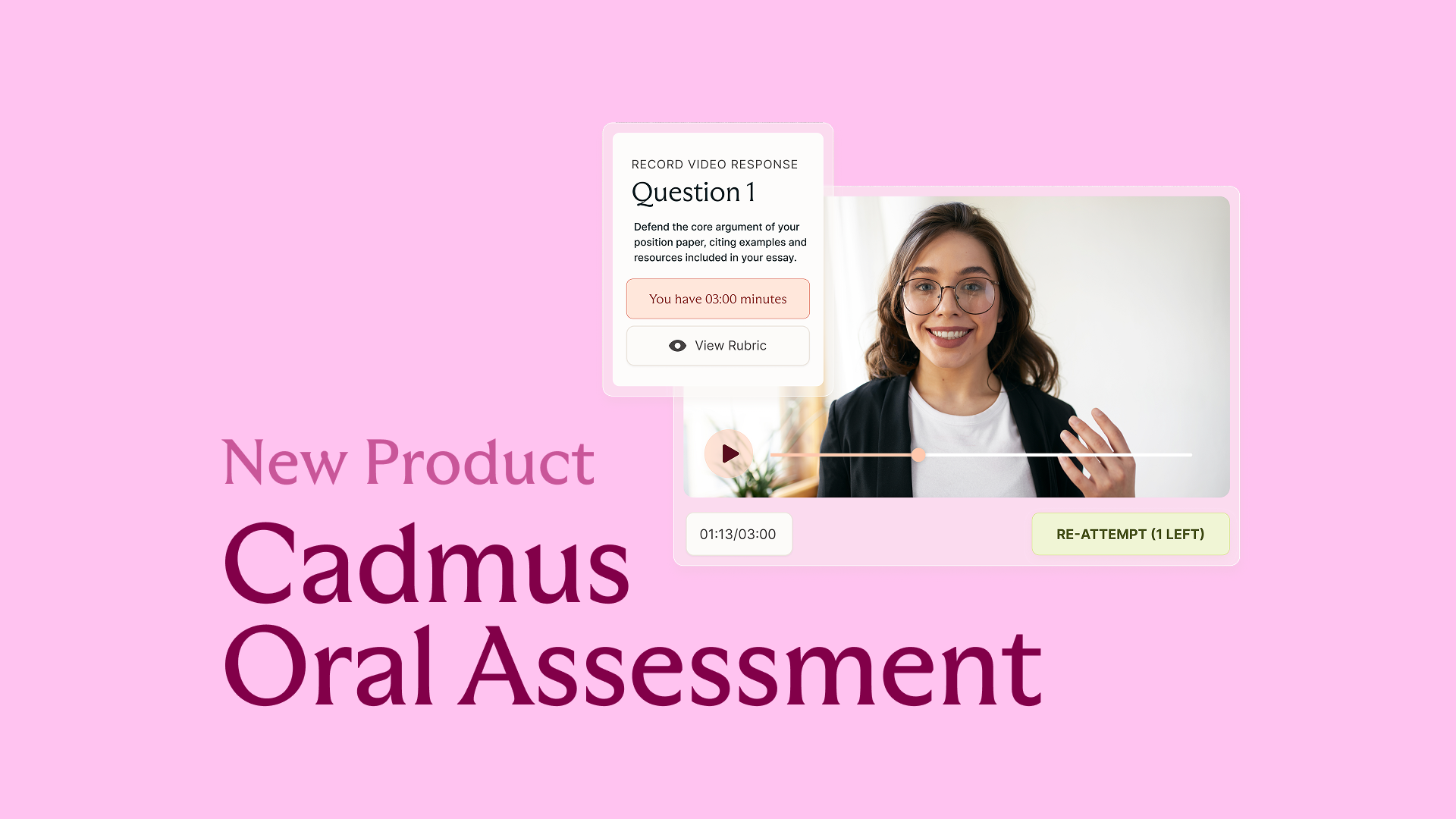
Introducing Cadmus Oral Assessment: Scalable assurance for an AI‑enabled world
Cadmus introduces Oral Assessment: a new approach to strengthening assessment assurance in an AI-enabled world. Starting with scalable, asynchronous vivas, this phased solution embeds targeted oral explanation directly into assessment workflows to provide more credible evidence of student learning.
2026-03-19