News
Secure assessment: From policy to practice



Share with colleagues
Download the full Case Study
Take an in-depth look at how educators have used Cadmus to better deliver assessments.
In recent years, assessment has taken on new significance in Australian higher education. Decisions once made primarily within courses and faculties are now being shaped by national policy, regulatory scrutiny, and growing expectations around equity, integrity, and public trust.
This shift has not happened in isolation. Three forces are now converging to make assessment one of the most consequential challenges facing university leaders:
- The rapid normalisation of generative AI
- Clearer expectations from TEQSA around systematic, programmatic assessment reform
- The Universities Accord’s positioning of assessment for learning as central to equity, integrity, and accountability
Together, these forces demand a step change, not just in what we assess, but in how assessment is designed, governed, and assured across the institution.
For many Australian institutions, this is the question they are arriving at the 2026 Universities Australia Solutions Summit grappling with: how do we translate policy intent into sustainable, day-to-day practice?
When policy expectations meet institutional reality
From a policy perspective, the direction is increasingly unambiguous. TEQSA has called for coherent, whole-of-program approaches to assessment design and assurance. The Universities Accord reinforces assessment as foundational to trust in Australian qualifications, particularly in regulated, professionally accredited, and national priority programs.
The challenge, however, is not one of principle. Across the sector, there is broad agreement on what needs to change. The difficulty lies in how those expectations are operationalised.
Assessment reform often remains fragmented: driven by local innovation, individual champions, or reactive responses to incidents rather than coordinated, institution-wide strategy. Under conditions of financial constraint and escalating workload pressure, this fragmentation is becoming harder to justify, and harder to sustain.
Generative AI has intensified this tension. While AI did not create weaknesses in assessment systems, it has exposed them rapidly and at scale. In doing so, it has highlighted the limits of responses that rely primarily on detection, investigation, or post-hoc enforcement—approaches that are proving costly, reactive, and increasingly misaligned with how learning actually happens.
This has prompted a deeper question: if enforcement alone is not sufficient, what should integrity look like in practice?
Integrity as an educative system, not an detection problem
That question sat at the centre of discussions at the recent University of Melbourne x Cadmus Teaching & Learning Forum.
A consistent theme to emerge was a shift in how integrity itself is understood. Rather than framing academic integrity as something to be policed, speakers emphasised the need to design with integrity, embedding ethical practice into assessment architecture, learning activities, and institutional culture.
This perspective aligns with an increasingly influential, multilayered and educative model of academic integrity, often described using the “Swiss Cheese Model.” Originally proposed by James Reason and later adapted for educational contexts by researchers such as Phillip Dawson and Margaret Bearman, the model recognises that no single intervention is sufficient. Instead, aligned layers—culture, capability-building, assessment design, secure environments, and proportionate enforcement—work together to reduce risk while actively supporting learning.
Importantly, Forum participants were clear that this does not imply a one-size-fits-all approach. Not every assessment needs to be “secure” in the same way. Instead, institutions must be deliberate about identifying critical assurance points—summative moments tied to progression, accreditation, or professional readiness—while allowing greater flexibility and creativity elsewhere.
This reframing shifts integrity from an enforcement problem to a design challenge, and places assessment architecture firmly within the remit of institutional leadership.
It also brings the role of secure assessment into sharper focus.
Why secure summative assessment still matters
As universities expand authentic, formative, and AI-enabled learning activities, clarity about assurance becomes more, not less, important.
Not all assessment needs to be locked down. But some summative assessment points—particularly those tied to progression, accreditation, or professional readiness—must remain secure to uphold academic standards and public trust.
However, secure assessment is too often defined narrowly across the sector as invigilated, proctored, or in-person. This framing risks conflating security with surveillance and constraining pedagogical innovation. Thoughtfully designed alternatives can achieve assessment integrity while supporting learner-centred curricula, equity, and confidence among students, staff, regulators, and employers alike.
The question facing institutions is no longer whether secure assessment is required, but how it can be implemented ethically, scalably, and in alignment with broader educational goals.
This is where many of the sector’s most active, and unresolved, conversations now sit, and where isolated solutions begin to fall short.
From fragmentation to whole-of-institution change
One of the strongest takeaways from the Teaching & Learning Forum was the need for alignment—between pedagogy, technology, policy, and governance.
Speakers described emerging approaches that bring these elements together: clear AI-use frameworks, authentic assessment design, staff capability-building, and enabling digital infrastructure, implemented as part of a coordinated reform effort rather than in isolation.
When aligned, assessment systems act as preventative mechanisms. They reduce misconduct, lower investigation volumes, and ease the burden placed on individual academics. Without alignment, institutions risk continuing to push systemic risk management onto staff already operating under significant workload pressure.
At the same time, whole-of-institution approaches make assessment practices more defensible under regulatory scrutiny, providing leaders with confidence that policy intent is being realised in practice.
Connection, credibility, and trust in a digital world
Beyond systems and policy, the Forum also surfaced something more human: the growing importance of connection.
As learning and assessment become more digital, the value of transparency, dialogue, and authentic engagement increases. Integrity, student success, and trust were repeatedly framed as inseparable—outcomes that emerge when assessment design reflects how students actually learn and develop capability.
Assessment reform is not simply about managing AI risk or meeting compliance requirements. It is about sustaining credibility, equity, and connection in a rapidly changing higher education landscape.
A shared leadership moment (and an ongoing conversation)
Assessment has become one of the most consequential policy frontiers in higher education. It shapes student experience, signals institutional values, and underpins national and international confidence in Australian qualifications.
The Teaching & Learning Forum demonstrated that the sector is already moving—from reaction to redesign, from enforcement to education, and from isolated solutions to shared frameworks. The Universities Australia Solutions Summit represents the next opportunity to continue that work together.
---
At the Summit, Cadmus will be hosting a lounge space to extend these conversations: practical, leadership-level discussions about how institutions are translating policy expectations into sustainable assessment practice. If these questions are already on your agenda, we would welcome the opportunity to continue the conversation with you—about what’s working, what’s challenging, and what assessment leadership looks like in practice.
Category
Assessment Design
Leadership
Teaching & Learning
More News
Load more


Product
How we use data at Cadmus
Being online creates new opportunities to understand how learning happens. Discover how Cadmus uses data to support learning, improve assessment design, and build transparency and trust across every stage of the assessment process.
Cadmus
2026-03-31



Academic Integrity
Leadership
Why detection-first integrity strategies are becoming a sunk cost for universities
In this article, Founder & Co-CEO Herk Kailis puts language to a growing tension across institutions: as the market leans further into detection, the response risks becoming more reactive than strategic. Through a commercial lens, he explores how this is beginning to resemble a classic sunk cost trap, and why the stronger long-term play is to design assessments that are harder to game in the first place.
Herk Kailis, Founder & Co-CEO, Cadmus
2026-03-30


Product update
Company
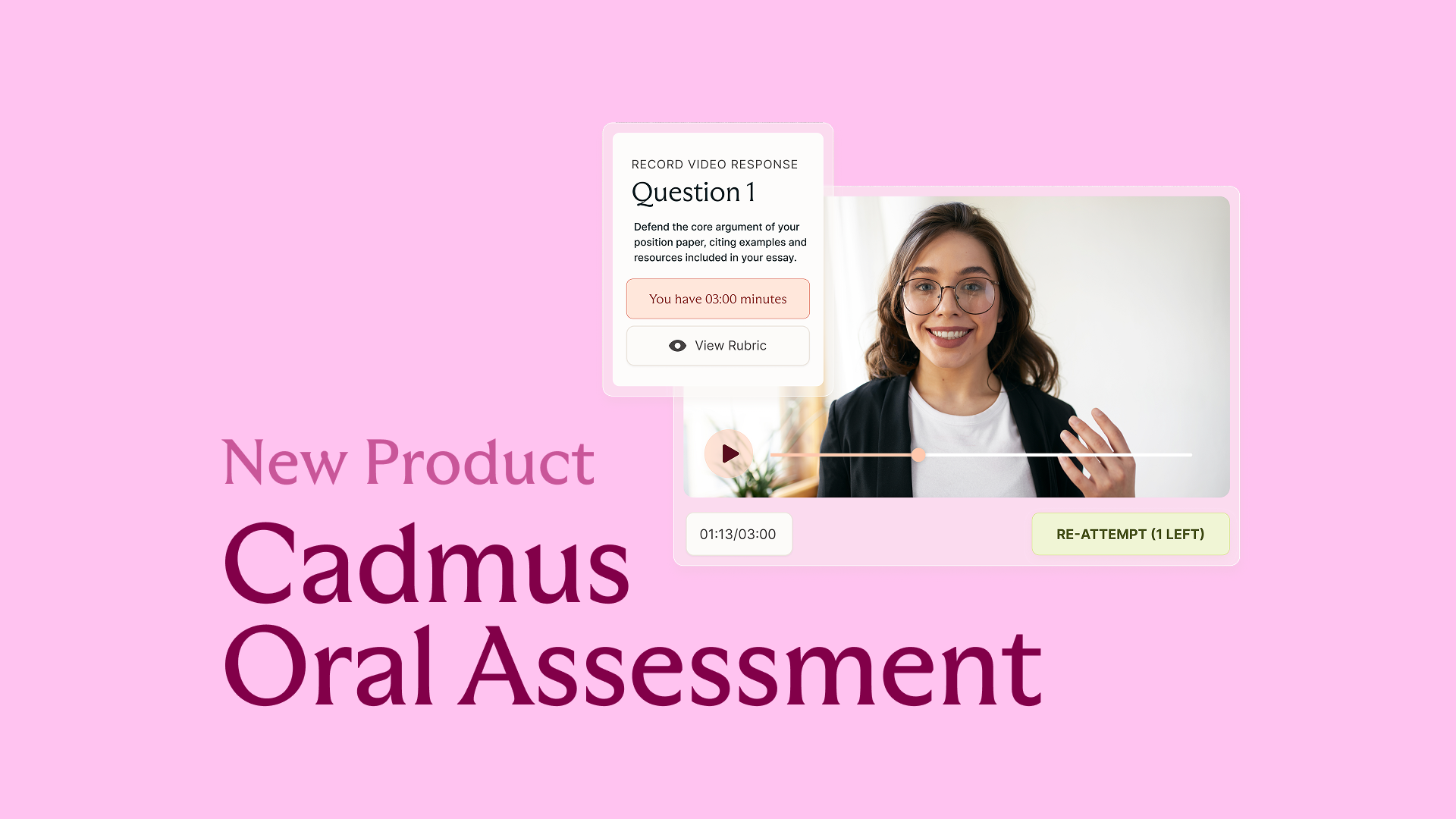
Introducing Cadmus Oral Assessment: Scalable assurance for an AI‑enabled world
Cadmus introduces Oral Assessment: a new approach to strengthening assessment assurance in an AI-enabled world. Starting with scalable, asynchronous vivas, this phased solution embeds targeted oral explanation directly into assessment workflows to provide more credible evidence of student learning.
2026-03-19